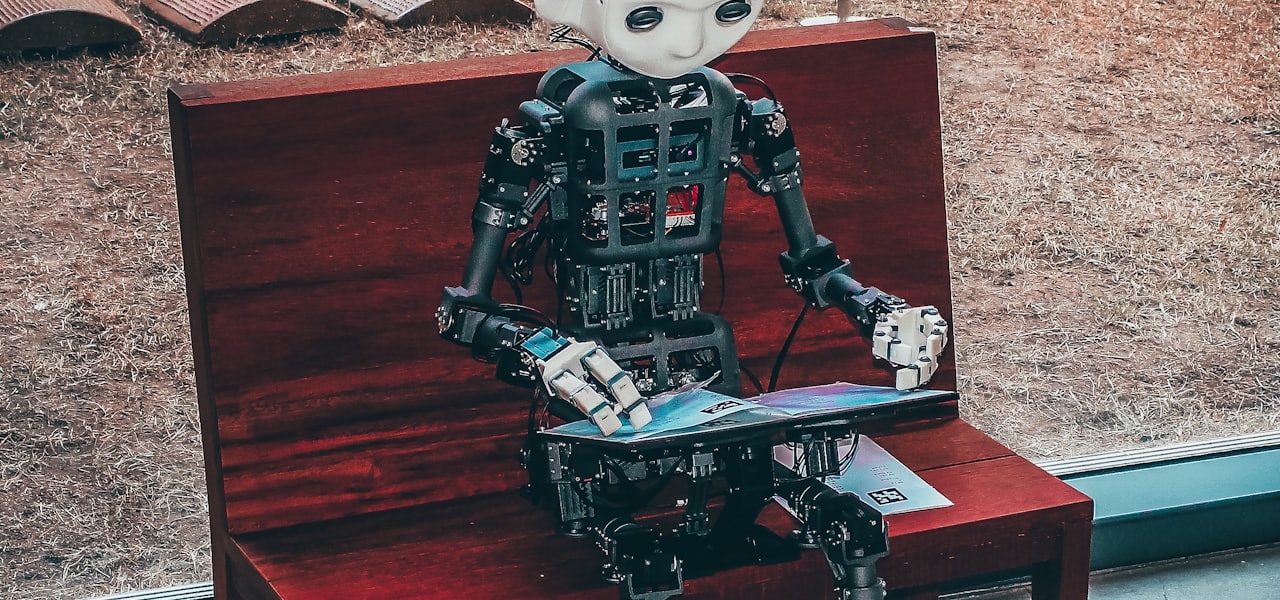
Artificial general intelligence (AGI) is a hypothetical type of artificial intelligence that matches or surpasses human capabilities across virtually all cognitive tasks. Beyond AGI, artificial superintelligence (ASI) would outperform the best human abilities across every domain by a wide margin. Unlike artificial narrow intelligence (ANI), whose competence is confined to well‑defined tasks, an AGI system can generalise knowledge, transfer skills between domains, and solve novel problems without task‑specific reprogramming. Creating AGI is a stated goal of technology companies such as OpenAI, Google, xAI, and Meta. A 2020 survey identified 72 active AGI research and development projects across 37 countries. AGI is a common topic in science fiction and futures studies. Contention exists over whether AGI represents an existential risk. Some AI experts and industry figures have stated that mitigating the risk of human extinction posed by AGI should be a global priority. Others find the development of AGI to be in too remote a stage to present such a risk. == Terminology == AGI is also known as strong AI, full AI, human-level AI, human-level intelligent AI, or general intelligent action. The term "artificial general intelligence" was used in 1997 by Mark Gubrud in a discussion of the implications of fully automated military production and operations. A mathematical formalism of AGI named AIXI was proposed in 2000 by Marcus Hutter, who defines intelligence as "an agent’s ability to achieve goals or succeed in a wide range of environments". This type of AGI has also been called "universal artificial intelligence". The term AGI was re-introduced and popularized by Shane Legg and Ben Goertzel around 2002. Some academic sources reserve the term "strong AI" for computer programs that will experience sentience or consciousness. In contrast, weak AI (or narrow AI) can solve a specific problem but lacks general cognitive abilities. Some academic sources use "weak AI" to refer more broadly to any programs that neither experience consciousness nor have a mind in the same sense as humans. Related concepts include artificial superintelligence and transformative AI. An artificial superintelligence (ASI) is a hypothetical type of AGI that is much more generally intelligent than humans, while the notion of transformative AI relates to AI having a large impact on society, for example, similar to the agricultural or industrial revolution. A framework for classifying AGI was proposed in 2023 by Google DeepMind researchers. They define five performance levels of AGI: emerging, competent, expert, virtuoso, and superhuman. For example, a competent AGI is defined as an AI that outperforms 50% of skilled adults in a wide range of non-physical tasks, and a superhuman AGI (i.e., an artificial superintelligence) is similarly defined but with a threshold of 100%. They consider large language models like ChatGPT or LLaMA 2 to be instances of emerging AGI (comparable to unskilled humans). Regarding the autonomy of AGI and associated risks, they define five levels: tool (fully in human control), consultant, collaborator, expert, and agent (fully autonomous). == Characteristics == There is no single agreed-upon definition of intelligence as applied to computers. Computer scientist John McCarthy wrote in 2007: "We cannot yet characterize in general what kinds of computational procedures we want to call intelligent." === Intelligence traits === Researchers generally hold that a system is required to do all of the following to be regarded as an AGI: reason, use strategy, solve puzzles, and make judgments under uncertainty, represent knowledge, including common sense knowledge, plan, learn, communicate in natural language, if necessary, integrate these skills in completion of any given goal. Many interdisciplinary approaches (e.g. cognitive science, computational intelligence, and decision making) consider additional traits such as imagination (the ability to form novel mental images and concepts) and autonomy. Computer-based systems exhibiting these capabilities are now widespread, with modern large language models demonstrating computational creativity, automated reasoning, and decision support simultaneously across domains. === Physical traits === Other capabilities are considered desirable in intelligent systems, as they may affect intelligence or aid in its expression. These include: the ability to sense (e.g. see, hear, etc.), and the ability to act (e.g. move and manipulate objects, change location to explore, etc.) This includes the ability to detect and respond to hazard. === Tests for human-level AGI === Several tests meant to confirm human-level AGI have been considered. ==== Turing test ==== The Turing test was proposed by Alan Turing in his 1950 paper "Computing Machinery and Intelligence". This test involves a human judge engaging in natural language conversations with both a human and a machine designed to generate human-like responses. The machine passes the test if it can convince the judge that it is human a significant fraction of the time. Turing proposed this as a practical measure of machine intelligence, focusing on the ability to produce human-like responses rather than on the internal workings of the machine. The idea of the test is that the machine has to try and pretend to be a man, by answering questions put to it, and it will only pass if the pretence is reasonably convincing. A considerable portion of a jury, who should not be experts about machines, must be taken in by the pretence. In 2014, a chatbot named Eugene Goostman, designed to imitate a 13-year-old Ukrainian boy, reportedly passed a Turing Test event by convincing 33% of judges that it was human. However, this claim was met with significant skepticism from the AI research community, who questioned the test's implementation and its relevance to AGI. A 2025 pre‑registered, three‑party Turing‑test study by Cameron R. Jones and Benjamin K. Bergen showed that GPT-4.5 was judged to be the human in 73% of five‑minute text conversations—surpassing the 67% humanness rate of real confederates and meeting the researchers' criterion for having passed the test. ==== Ikea test ==== The "Ikea test", also known as the Flat Pack Furniture Test, involves an AI controlling a robot which attempts to assemble an Ikea flat-pack furniture product after having been shown the parts and instructions. As early as 2013, MIT's IkeaBot demonstrated fully autonomous multi-robot assembly of an IKEA Lack table in ten minutes, with no human intervention and no pre-programmed assembly instructions. The robots inferred the assembly sequence from the geometry of the parts alone. ==== Coffee test ==== Steve Wozniak proposed a test where a machine is required to enter an average American home and figure out how to make coffee. It must find the coffee machine, find the coffee, add water, find a mug, and brew the coffee by pushing the proper buttons. This test has been substantially approached across multiple systems. In January 2024, Figure AI's Figure 01 humanoid learned to operate a Keurig coffee machine autonomously after watching video demonstrations, using end-to-end neural networks to translate visual input into motor actions. In 2025, researchers at the University of Edinburgh published the ELLMER framework in Nature Machine Intelligence, demonstrating a robotic arm that interprets verbal instructions, analyses its surroundings, and autonomously makes coffee in dynamic kitchen environments — adapting to unforeseen obstacles in real time rather than following pre-programmed sequences. ==== Suleyman's test ==== Mustafa Suleyman's test proposes giving an AI model US$100,000 and asking it to obtain US$1 million. ==== Use of video-games ==== Adams, et al. propose that the ability to learn and succeed in a wide range of video games can be used to test AI intelligence. This range would include games unknown to the AGI developers before the test is administered. === AI-complete problems === A problem is informally called "AI-complete" or "AI-hard" if it is believed that AGI would be needed to solve it, because the solution is beyond the capabilities of a purpose-specific algorithm. == History == === Classical AI === Modern AI research began in the mid-1950s. The first generation of AI researchers were convinced that artificial general intelligence was possible and that it would exist in just a few decades. AI pioneer Herbert A. Simon wrote in 1965: "machines will be capable, within twenty years, of doing any work a man can do". Their predictions were the inspiration for Stanley Kubrick and Arthur C. Clarke's fictional character HAL 9000, who embodied what AI researchers believed they could create by the year 2001. AI pioneer Marvin Minsky was a consultant on the project of making HAL 9000 as realistic as possible according to the consensus predictions of the time. He said in 1967, "Within a generation... the problem of
Thai QR Payment
Thai QR Payment or PromptPay (พร้อมเพย์) is a real-time payment system in Thailand that allows money transfers through digital channels using identifiers linked to a bank account, including a mobile phone number, citizen identification number, tax identification number or bank account number. The system was introduced in 2016 as part of Thailand's national e-payment infrastructure and was developed under the National e-Payment Master Plan, a government programme intended to expand digital payment infrastructure and reduce the use of cash in everyday transactions. It is owned by National ITMX ltd and Bank of Thailand and developed by Vocalink, a group by Mastercard == History == PromptPay (originally AnyID) is one of the National e-Payment projects and policies by Thailand, to regulate and standardize electronic payments to follow the technologies with internet and smartphones that is expanding and bringing technology into Finance and Commerce. By 22 December 2015, The First Prayut cabinet have approved the project as a national infastructure PromptPay has also been used in cross-border payment linkages with other real-time payment systems in Southeast Asia. In April 2021, the Monetary Authority of Singapore and the Bank of Thailand launched a linkage between Singapore's PayNow and Thailand's PromptPay, allowing customers of participating banks to send money between the two countries using a mobile phone number. In June 2021, the central banks of Thailand and Malaysia launched a cross-border QR payment linkage between PromptPay and Malaysia's DuitNow system. == Services == PromptPay's Services have included Encrypted Transactions and Payment between Two Individuals (C2C) Government Infrastructure Payment Tax Returns Individual PromptPay e-Wallet Thai QR Payment Pay Alert e-Donation Cross Border QR Payment
Death of Elaine Herzberg
The death of Elaine Herzberg (August 2, 1968 – March 18, 2018) was the first recorded case of a pedestrian fatality involving a self-driving car, after a collision that occurred late in the evening of March 18, 2018. Herzberg was pushing a bicycle across a four-lane road in Tempe, Arizona, United States, when she was struck by an Uber test vehicle, which was operating in self-drive mode with a human safety backup driver sitting in the driving seat. Herzberg was taken to the local hospital where she died of her injuries. Following the fatal incident, the National Transportation Safety Board (NTSB) issued a series of recommendations and sharply criticized Uber. The company suspended testing of self-driving vehicles in Arizona, where such testing had been approved since August 2016. Uber chose not to renew its permit for testing self-driving vehicles in California when it expired at the end of March 2018. Uber resumed testing in December 2018, starting in Pittsburgh, Pennsylvania. In March 2019, Arizona prosecutors ruled that Uber was not criminally responsible for the crash. The back-up driver of the vehicle was charged with negligent homicide, pled guilty to endangerment, and was sentenced to three years' probation. While Herzberg was the first pedestrian killed by a self-driving car, driver Gao Yaning died in a Tesla semi-autonomous car two years earlier. A reporter for The Washington Post compared Herzberg's fate with that of Bridget Driscoll who, in the United Kingdom in 1896, was the first pedestrian to be killed by an automobile. The Arizona incident has magnified the importance of collision avoidance systems for self-driving vehicles. == Collision summary == Herzberg was crossing Mill Avenue (North) from west to east, approximately 360 feet (110 m) south of the intersection with Curry Road, outside the designated pedestrian crosswalk, close to the Red Mountain Freeway. She was pushing a bicycle laden with shopping bags, and had crossed at least two lanes of traffic when she was struck at approximately 9:58 pm MST (UTC−07:00) by a prototype Uber self-driving car based on a Volvo XC90, which was traveling north on Mill. The vehicle had been operating in autonomous mode since 9:39 pm, nineteen minutes before it struck and killed Herzberg. The car's human safety backup driver, Rafaela Vasquez, did not intervene in time to prevent the collision. Vehicle telemetry obtained after the crash showed that the human operator responded by moving the steering wheel less than a second before impact, and she engaged the brakes less than a second after impact. == Cause investigation == The county district attorney's office recused itself from the investigation, due to a prior joint partnership with Uber promoting their services as an alternative to driving under the influence of alcohol. Accounts differ on the speed limit at the place of the incident. According to Tempe police the car was traveling in a 35 mph (56 km/h) zone, but this is contradicted by a posted speed limit of 45 mph (72 km/h). The National Transportation Safety Board (NTSB) sent a team of federal investigators to gather data from vehicle instruments, and to examine vehicle condition along with the actions taken by the safety driver. Their preliminary findings were substantiated by multiple event data recorders and proved the vehicle was traveling 43 miles per hour (69 km/h) when Herzberg was first detected 6 seconds (378 feet (115 m)) before impact; during 4.7 seconds the self driving system did not infer that emergency braking was needed. A vehicle traveling 43 mph (69 km/h) can generally stop within 89 feet (27 m) once the brakes are applied. The machine needed to be 1.3 seconds (82 feet (25 m)) away prior to discerning that emergency braking was required, whereas at least that much distance was required to stop. The system failed to behave properly. A total stopping distance of 76 feet itself would imply a safe speed under 25 mph (40 km/h). Human intervention was still legally required. Computer perception–reaction time would have been a speed limiting factor had the technology been superior to humans in ambiguous situations; however, the nascent computerized braking technology was disabled the day of the crash, and the machine's apparent 4.7-second perception–reaction (alarm) time allowed the car to travel 250 feet (76 m). Video released by the police on March 21 showed the safety driver was not watching the road moments before the vehicle struck Herzberg. === Environment === In widely disseminated remarks that would shape the narrative about the crash, which were later seen as prejudicial and subsequently contradicted by her own department, Tempe Police Chief Sylvia Moir was quoted stating that the collision was "unavoidable" based on the initial police investigation, which included a review of the video captured by an onboard camera. Moir faulted Herzberg for crossing the road in an unsafe manner: "It is dangerous to cross roadways in the evening hour when well-illuminated, managed crosswalks are available." According to Uber, safety drivers were trained to keep their hands very close to the wheel all the time while driving the vehicle so they were ready to quickly take control if necessary. The driver said it was like a flash, the person walked out in front of them. His [sic] first alert to the collision was the sound of the collision. [...] it's very clear it would have been difficult to avoid this collision in any kind of mode (autonomous or human-driven) based on how she came from the shadows right into the roadway. Tempe police released video on March 21, 2018, showing footage recorded by two onboard cameras: one forward-looking, and one capturing the safety driver's actions. The forward-facing video shows that the self-driving car was traveling in the far right lane when it struck Herzberg. The driver-facing video shows the safety driver was looking down prior to the collision. The Uber operator is responsible for intervening and taking manual control when necessary as well as for monitoring diagnostic messages, which are displayed on a screen in the center console. In an interview conducted after the crash with NTSB, the driver stated she was monitoring the center stack at the time of the collision. After the Uber video was released, journalist Carolyn Said noted the police explanation of Herzberg's path meant she had already crossed two lanes of traffic before she was struck by the autonomous vehicle. The Marquee Theatre and Tempe Town Lake are west of Mill Avenue, and pedestrians commonly cross mid-street without detouring north to the crosswalk at Curry. According to reporting by the Phoenix New Times, Mill Avenue contains what appears to be a brick-paved path in the median between the northbound and southbound lanes; however, posted signs prohibit pedestrians from crossing in that location. When the second of the Mill Avenue bridges over the town lake was added in 1994 for northbound traffic, the X-shaped crossover in the median was installed to accommodate the potential closing of one of the two road bridges. The purpose of this brick-paved structure is purely to divert cars from one side to the other if a bridge is closed to traffic, and although it may look like a crosswalk for pedestrians, it is in fact a temporary roadway with vertical curbs and warning signs. === Software issues === Michael Ramsey, a self-driving car expert with Gartner, characterized the video as showing "a complete failure of the system to recognize an obviously seen person who is visible for quite some distance in the frame. Uber has some serious explaining to do about why this person wasn't seen and why the system didn't engage." The NTSB preliminary report, however, noted that the software did order the car to brake 1.3 seconds before the collision. A video shot from the vehicle's dashboard camera showed the safety driver looking down, away from the road. It also appeared that the driver's hands were not hovering above the steering wheel, which is what drivers are instructed to do so they can quickly retake control of the car. Uber had moved from two employees in every car to one. The paired employees had been splitting duties: one ready to take over if the autonomous system failed, and another to keep an eye on what the computers were detecting. The second person was responsible for keeping track of system performance as well as labeling data on a laptop computer. Mr. Kallman, the Uber spokesman, said the second person was in the car for purely data related tasks, not safety. When Uber moved to a single operator, some employees expressed safety concerns to managers, according to the two people familiar with Uber's operations. They were worried that going solo would make it harder to remain alert during hours of monotonous driving. The recorded telemetry showed the system had detected Herzberg six seconds before the crash, and classified her first as an unknown object, then as a
Someday (short story)
"Someday" is a science fiction short story by American writer Isaac Asimov. It was first published in the August 1956 issue of Infinity Science Fiction and reprinted in the collections Earth Is Room Enough (1957), The Complete Robot (1982), Robot Visions (1990), and The Complete Stories, Volume 1 (1990). == Plot summary == The story is set in a future where computers play a central role in organizing society. Humans are employed as computer operators, but they leave most of the thinking to machines. Indeed, whilst binary programming is taught at school, reading and writing have become obsolete. The story concerns a pair of boys who dismantle and upgrade an old Bard, a child's computer whose sole function is to generate random fairy tales. The boys download a book about computers into the Bard's memory in an attempt to expand its vocabulary, but the Bard simply incorporates computers into its standard fairy tale repertoire. The story ends with the boys excitedly leaving the room after deciding to go to the library to learn "squiggles" (writing) as a means of passing secret messages to one another. As they leave, one of the boys accidentally kicks the Bard's on switch. The Bard begins reciting a new story about a poor mistreated and often ignored robot called the Bard, whose sole purpose is to tell stories, which ends with the words: "the little computer knew then that computers would always grow wiser and more powerful until someday—someday—someday—…"
Riffusion
Riffusion is a neural network, designed by Seth Forsgren and Hayk Martiros, that generates music using images of sound rather than audio. The resulting music has been described as "de otro mundo" (otherworldly), although unlikely to replace man-made music. The model was made available on December 15, 2022, with the code also freely available on GitHub. The first version of Riffusion was created as a fine-tuning of Stable Diffusion, an existing open-source model for generating images from text prompts, on spectrograms, resulting in a model which used text prompts to generate image files which could then be put through an inverse Fourier transform and converted into audio files. While these files were only several seconds long, the model could also use latent space between outputs to interpolate different files together (using the img2img capabilities of SD). It was one of many models derived from Stable Diffusion. In December 2022, Mubert similarly used Stable Diffusion to turn descriptive text into music loops. In January 2023, Google published a paper on their own text-to-music generator called MusicLM. Forsgren and Martiros formed a startup, also called Riffusion, and raised $4 million in venture capital funding in October 2023.
Aporia (company)
Aporia is a machine learning observability platform based in Tel Aviv, Israel. The company has a US office located in San Jose, California. Aporia has developed software for monitoring and controlling undetected defects and failures used by other companies to detect and report anomalies, and warn in the early stages of faults. == History == Aporia was founded in 2019 by Liran Hason and Alon Gubkin. In April 2021, the company raised a $5 million seed round for its monitoring platform for ML models. In February 2022, the company closed a Series A round of $25 million for its ML observability platform. Aporia was named by Forbes as the Next Billion-Dollar Company in June 2022. In November, the company partnered with ClearML, an MLOPs platform, to improve ML pipeline optimization. In January 2023, Aporia launched Direct Data Connectors, a novel technology allowing organizations to monitor their ML models in minutes (previously the process of integrating ML monitoring into a customer’s cloud environment took weeks or more.) DDC (Direct Data Connectors) enables users to connect Aporia to their preferred data source and monitor all of their data at once, without data sampling or data duplication (which is a huge security risk for major organizations. In April 2023, Aporia announced the company partnered with Amazon Web Services (AWS) to provide more reliable ML observability to AWS consumers by deploying Aporia's architecture to their AWS environment, this will allow customers to monitor their models in production regardless of platform.
Fuzzy measure theory
In mathematics, fuzzy measure theory considers generalized measures in which the additive property is replaced by the weaker property of monotonicity. The central concept of fuzzy measure theory is the fuzzy measure (also capacity, see ), which was introduced by Choquet in 1953 and independently defined by Sugeno in 1974 in the context of fuzzy integrals. There exists a number of different classes of fuzzy measures including plausibility/belief measures, possibility/necessity measures, and probability measures, which are a subset of classical measures. == Definitions == Let X {\displaystyle \mathbf {X} } be a universe of discourse, C {\displaystyle {\mathcal {C}}} be a class of subsets of X {\displaystyle \mathbf {X} } , and E , F ∈ C {\displaystyle E,F\in {\mathcal {C}}} . A function g : C → R {\displaystyle g:{\mathcal {C}}\to \mathbb {R} } where ∅ ∈ C ⇒ g ( ∅ ) = 0 {\displaystyle \emptyset \in {\mathcal {C}}\Rightarrow g(\emptyset )=0} E ⊆ F ⇒ g ( E ) ≤ g ( F ) {\displaystyle E\subseteq F\Rightarrow g(E)\leq g(F)} is called a fuzzy measure. A fuzzy measure is called normalized or regular if g ( X ) = 1 {\displaystyle g(\mathbf {X} )=1} . == Properties of fuzzy measures == A fuzzy measure is: additive if for any E , F ∈ C {\displaystyle E,F\in {\mathcal {C}}} such that E ∩ F = ∅ {\displaystyle E\cap F=\emptyset } , we have g ( E ∪ F ) = g ( E ) + g ( F ) . {\displaystyle g(E\cup F)=g(E)+g(F).} ; supermodular if for any E , F ∈ C {\displaystyle E,F\in {\mathcal {C}}} , we have g ( E ∪ F ) + g ( E ∩ F ) ≥ g ( E ) + g ( F ) {\displaystyle g(E\cup F)+g(E\cap F)\geq g(E)+g(F)} ; submodular if for any E , F ∈ C {\displaystyle E,F\in {\mathcal {C}}} , we have g ( E ∪ F ) + g ( E ∩ F ) ≤ g ( E ) + g ( F ) {\displaystyle g(E\cup F)+g(E\cap F)\leq g(E)+g(F)} ; superadditive if for any E , F ∈ C {\displaystyle E,F\in {\mathcal {C}}} such that E ∩ F = ∅ {\displaystyle E\cap F=\emptyset } , we have g ( E ∪ F ) ≥ g ( E ) + g ( F ) {\displaystyle g(E\cup F)\geq g(E)+g(F)} ; subadditive if for any E , F ∈ C {\displaystyle E,F\in {\mathcal {C}}} such that E ∩ F = ∅ {\displaystyle E\cap F=\emptyset } , we have g ( E ∪ F ) ≤ g ( E ) + g ( F ) {\displaystyle g(E\cup F)\leq g(E)+g(F)} ; symmetric if for any E , F ∈ C {\displaystyle E,F\in {\mathcal {C}}} , we have | E | = | F | {\displaystyle |E|=|F|} implies g ( E ) = g ( F ) {\displaystyle g(E)=g(F)} ; Boolean if for any E ∈ C {\displaystyle E\in {\mathcal {C}}} , we have g ( E ) = 0 {\displaystyle g(E)=0} or g ( E ) = 1 {\displaystyle g(E)=1} . Understanding the properties of fuzzy measures is useful in application. When a fuzzy measure is used to define a function such as the Sugeno integral or Choquet integral, these properties will be crucial in understanding the function's behavior. For instance, the Choquet integral with respect to an additive fuzzy measure reduces to the Lebesgue integral. In discrete cases, a symmetric fuzzy measure will result in the ordered weighted averaging (OWA) operator. Submodular fuzzy measures result in convex functions, while supermodular fuzzy measures result in concave functions when used to define a Choquet integral. == Möbius representation == Let g be a fuzzy measure. The Möbius representation of g is given by the set function M, where for every E , F ⊆ X {\displaystyle E,F\subseteq X} , M ( E ) = ∑ F ⊆ E ( − 1 ) | E ∖ F | g ( F ) . {\displaystyle M(E)=\sum _{F\subseteq E}(-1)^{|E\backslash F|}g(F).} The equivalent axioms in Möbius representation are: M ( ∅ ) = 0 {\displaystyle M(\emptyset )=0} . ∑ F ⊆ E | i ∈ F M ( F ) ≥ 0 {\displaystyle \sum _{F\subseteq E|i\in F}M(F)\geq 0} , for all E ⊆ X {\displaystyle E\subseteq \mathbf {X} } and all i ∈ E {\displaystyle i\in E} A fuzzy measure in Möbius representation M is called normalized if ∑ E ⊆ X M ( E ) = 1. {\displaystyle \sum _{E\subseteq \mathbf {X} }M(E)=1.} Möbius representation can be used to give an indication of which subsets of X interact with one another. For instance, an additive fuzzy measure has Möbius values all equal to zero except for singletons. The fuzzy measure g in standard representation can be recovered from the Möbius form using the Zeta transform: g ( E ) = ∑ F ⊆ E M ( F ) , ∀ E ⊆ X . {\displaystyle g(E)=\sum _{F\subseteq E}M(F),\forall E\subseteq \mathbf {X} .} == Simplification assumptions for fuzzy measures == Fuzzy measures are defined on a semiring of sets or monotone class, which may be as granular as the power set of X, and even in discrete cases the number of variables can be as large as 2|X|. For this reason, in the context of multi-criteria decision analysis and other disciplines, simplification assumptions on the fuzzy measure have been introduced so that it is less computationally expensive to determine and use. For instance, when it is assumed the fuzzy measure is additive, it will hold that g ( E ) = ∑ i ∈ E g ( { i } ) {\displaystyle g(E)=\sum _{i\in E}g(\{i\})} and the values of the fuzzy measure can be evaluated from the values on X. Similarly, a symmetric fuzzy measure is defined uniquely by |X| values. Two important fuzzy measures that can be used are the Sugeno- or λ {\displaystyle \lambda } -fuzzy measure and k-additive measures, introduced by Sugeno and Grabisch respectively. === Sugeno λ-measure === The Sugeno λ {\displaystyle \lambda } -measure is a special case of fuzzy measures defined iteratively. It has the following definition: ==== Definition ==== Let X = { x 1 , … , x n } {\displaystyle \mathbf {X} =\left\lbrace x_{1},\dots ,x_{n}\right\rbrace } be a finite set and let λ ∈ ( − 1 , + ∞ ) {\displaystyle \lambda \in (-1,+\infty )} . A Sugeno λ {\displaystyle \lambda } -measure is a function g : 2 X → [ 0 , 1 ] {\displaystyle g:2^{X}\to [0,1]} such that g ( X ) = 1 {\displaystyle g(X)=1} . if A , B ⊆ X {\displaystyle A,B\subseteq \mathbf {X} } (alternatively A , B ∈ 2 X {\displaystyle A,B\in 2^{\mathbf {X} }} ) with A ∩ B = ∅ {\displaystyle A\cap B=\emptyset } then g ( A ∪ B ) = g ( A ) + g ( B ) + λ g ( A ) g ( B ) {\displaystyle g(A\cup B)=g(A)+g(B)+\lambda g(A)g(B)} . As a convention, the value of g at a singleton set { x i } {\displaystyle \left\lbrace x_{i}\right\rbrace } is called a density and is denoted by g i = g ( { x i } ) {\displaystyle g_{i}=g(\left\lbrace x_{i}\right\rbrace )} . In addition, we have that λ {\displaystyle \lambda } satisfies the property λ + 1 = ∏ i = 1 n ( 1 + λ g i ) {\displaystyle \lambda +1=\prod _{i=1}^{n}(1+\lambda g_{i})} . Tahani and Keller as well as Wang and Klir have shown that once the densities are known, it is possible to use the previous polynomial to obtain the values of λ {\displaystyle \lambda } uniquely. === k-additive fuzzy measure === The k-additive fuzzy measure limits the interaction between the subsets E ⊆ X {\displaystyle E\subseteq X} to size | E | = k {\displaystyle |E|=k} . This drastically reduces the number of variables needed to define the fuzzy measure, and as k can be anything from 1 (in which case the fuzzy measure is additive) to X, it allows for a compromise between modelling ability and simplicity. ==== Definition ==== A discrete fuzzy measure g on a set X is called k-additive ( 1 ≤ k ≤ | X | {\displaystyle 1\leq k\leq |\mathbf {X} |} ) if its Möbius representation verifies M ( E ) = 0 {\displaystyle M(E)=0} , whenever | E | > k {\displaystyle |E|>k} for any E ⊆ X {\displaystyle E\subseteq \mathbf {X} } , and there exists a subset F with k elements such that M ( F ) ≠ 0 {\displaystyle M(F)\neq 0} . == Shapley and interaction indices == In game theory, the Shapley value or Shapley index is used to indicate the weight of a game. Shapley values can be calculated for fuzzy measures in order to give some indication of the importance of each singleton. In the case of additive fuzzy measures, the Shapley value will be the same as each singleton. For a given fuzzy measure g, and | X | = n {\displaystyle |\mathbf {X} |=n} , the Shapley index for every i , … , n ∈ X {\displaystyle i,\dots ,n\in X} is: ϕ ( i ) = ∑ E ⊆ X ∖ { i } ( n − | E | − 1 ) ! | E | ! n ! [ g ( E ∪ { i } ) − g ( E ) ] . {\displaystyle \phi (i)=\sum _{E\subseteq \mathbf {X} \backslash \{i\}}{\frac {(n-|E|-1)!|E|!}{n!}}[g(E\cup \{i\})-g(E)].} The Shapley value is the vector ϕ ( g ) = ( ψ ( 1 ) , … , ψ ( n ) ) . {\displaystyle \mathbf {\phi } (g)=(\psi (1),\dots ,\psi (n)).}